

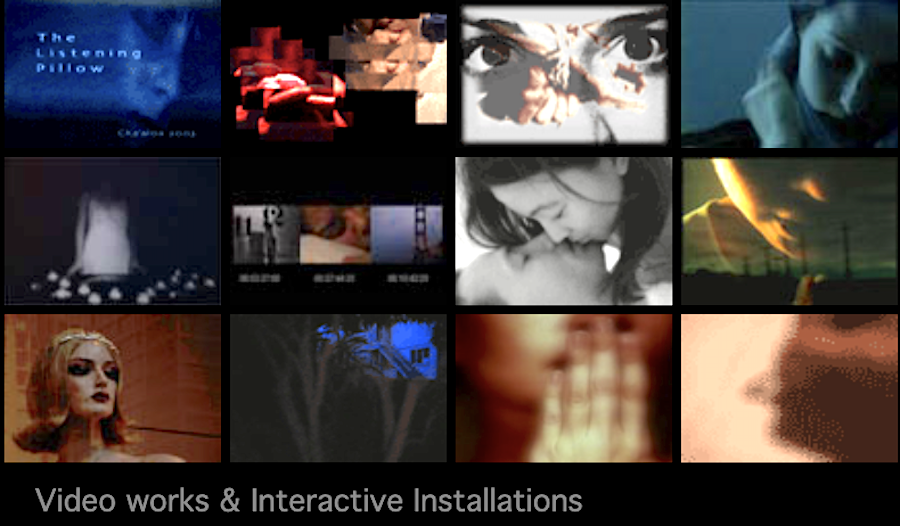
The Listening Pillow is an interactive video installation in which the participant is lost in a labyrinth of collective memory and subconscious stream, stored in a pillow, which recorded a “sleeper’s” dreams.
By navigating through a spatial framework of soundscapes and fragmented video stories, the viewer recreates the sleeper’s lost identity through a network of stored memories. In the greater social context of the technological body “where-body” (where is my body) or Otherness , this work seeks to address the issue of identity, memory and technological dis-embodiment.
Technology allows us to live and navigate via a dis-embodied state. A prime example are the gaming environment, where players use avatars to connect with estranged identities on the screen. Communicating behind the technological screen, can the corporeal body (the origin of our identity) be replaced and rendered obsolete?
And if the ‘real’ can easily be ‘aliased’, then what of the displaced identities we hold?
For my MFACA thesis, I created two versions of The Listening Pillow Interactive Video Installation – a physical installation in a gallery and an interactive dvd.

A Personal Exploration: On Dreams, the New Media Narratives and Interactive Storytelling.
We live in a non-linear world.
Linearity, in a traditional storylines and narratives, are a forced construct- an illusory attempt of the mind to force chronological order out of a natural state of chaotic events and occurrences.
A single story is endless; until the reader or author draws a conclusion.
If we watch a 2-hour film of a story or see a theatre play, it has a chronological beginning and end. If we read a book, we come to page 350 where the author has tied up a story of four characters, into a tidy and cohesive linear conclusion. Everything follows a linear and chronological path as if they are a natural progression of events.
However, real life is linear. Time is not linear. It’s messy, chaotic, where each moment has its own life of simultaneous occurrences, stories and alternate realities. A quantum existence.
In the quantum field, there are always going to be multiple streams of narratives, various endpoints, beginnings and alternate conclusions.
Dissembled a story’s pieces may appear ‘irrational”, “chaotic”; yet, the mind forces a bridge, it builds relationships to find meaning in. In editing video stories -television, film- we force a linear progression of a singular logical conclusion.
However, in the subconscious, dream language erupts with mysterious symbols that are explosive of ideas and emotions which collide, clash and combine to form expression and healing of the shadow self. No bridge is necessary. All makes sense in its chaos and instability. Multiple ideas and meanings are enmeshed in non-linear stories which encapsulate “the bigger picture” meaning.
Pieces of a story are fragmented, interchangeable units.
In interactive gaming, this notion of’ multiple streams” and hybridized narratives are often practiced and imitate the preceding concepts of the “create your own adventure” MS-Dos games and mystery books of the ’80s. [G.Weinbren]
The world wide web is also a prime example and visual representation of how the mind bridges networks, multiple streams and links to various sources of meaning and information.
Lev Manovich ties the natural state of non-linear story-telling to roots in the film production process, where shots are collected and edited from non-chronological sequence. Through editing, shots are stored in a database and then assembled to create a story.
‘The Listening Pillow’ draws upon these ideas and the concept of non-linear time, multiple streams and… a single still photograph.
“Take a single photograph. Image, composition, subject matter, lighting… all possess narratives independent from one another. Placed together in one shot, this image creates a symphony of visual meaning; it is a collision of linguistic variables and values tied within an instant of capture. The shot creates ‘a fixed point of reference’ and also reminds us the condition is both, temporal and eternal.” [Roland Barthes]
Bridging from earlier works with box sculpture and assemblage narratives, my video work in interactive storytelling, often feels like an act of recovering memory. I explore linguistics through photographs, video, non-linear editing and interactive possibilities to deal with ideas of body/performance, memory, identity and space. My work seeks to speak through dreams, photographs … and expresses itself in either a memory, a mood, a song, dance or story.
Check out my Bibliography
- By Christine Ka’aloa
The Listening Pillow Interactive Installation version:
The interactive installation is shaped by the participants’ live physical experience in the space, sound space and bed installation. In this version, the participant is the vessel for the disembodied dreamer… they are in fact, the dreamer’s physical body. The user is the avatar. The electronics, bed, video and sound database are brought together by the real ghost in the machine… the programming language itself (in this case, Lingo scripting which is used for gaming and interactive arts).
In the room there is an empty bed, a pillow and a projection screen overhead, casting a video of a sleeping woman, whom we can hear deeply breathing in dream state. Viewers lie upon the bed and navigate through a pressure-sensitive pillow, via head movements, accessing a database storing 36 audio & video compositions,One can affect one’s own experience of the dream through nested controls hidden in the body of the pillow, which trigger speed and video track changes. Thus, no one experience is the same or can be duplicated as the participant’s interaction with the dream narratives can have endless/multiple branches and affectations.
The Listening Pillow Project Goals:
a) simulate the experience of dreaming,
b) invite questions surrounding new identities within the technological body (Real identity vs Other-ness/Avatar/Where-body).
c) create an interactive performative experience in which the viewer role is both, passive viewing and yet performer.
How The Listening Pillow Works (Documentation Video)
- Schematics & Main components
- interactive storytelling/gaming explorations
- Photo Essay: Journey into Ink, 2000
- My Bibliography for this project
The Listening Pillow contains nine dreams or short vignette stories, exploring issues such as:
- The Muse: An invocation to nature (filmed during 9/11)
- Sandman Stories: childhood memory
- Running Time: stuck reversed time loop actions, What is real time? Is it recorded, experienced or perceived?
- Touch: the conflicting relationship between the mind and body memory,
- The Symphony: body gestures and sound, (Inspired by My Toy Piano interactive)
- The Writ: body confessions and cleansing
- Silk: Water, memory and strangulation
- Anger House: anger as an ‘entity’ and trickster
- Between Black & White: sensation, experiencing, Otherness meshed with self and the boundaries, which keep the two from becoming one.
The Listening Pilllow: A StandAlone Interactive DVD:
The viewer is given several options of interactivity with the dreamer’s dreams . With the StandAlone version, the dreamer sleeps and triggers its own dreams. Through the use of hot buttons, multiple audio & video tracks, the viewer is given to option of making a “lucid” decision to change the course of the dreams or connect through them.
The interactive dvd incorporates my Computer Arts studies in interactive interface and the progression of video to dvd design. This version does not require hard-wired programming like the physical installation; instead is like a tree of If, Then push button executions that can simulate a similar scenario of a Create your own story scenario.
Finally, the last option is to engage through the Menu button- which allows one to view the dreams individually. Through the menu, there are instructions, a list of viewing choices & a Documentation video of the original installation piece is accessed through this last option.
The dvd is best watched on a computer but its interactive features work on a dvd player with remote also!
Credits & Thanks to all my friends and family:
Technical:
Thesis Advisor & Programming Support: Wells Packard
Electronics Advisor: Todd Brous
Performers :
Tia Castro
Bain Coffman
Lauren DeBenedetta
Dennis Miller
Monika Lilleike
Melanie Yang
* All audio narrative performance works have been sound-design and edited in ProTools.
- Text for “Silk” (experimental audio composition) by Anais Nin, House of Incest.
- Text for “The Muse ” by Wolfgang Goethe, Faust.
- Text for “Touch” were written by Christine Kaaloa, in partial collaboration with Dennis Miller Text for
- “Anger/House” written by Christine Kaaloa
© christine ka’aloa